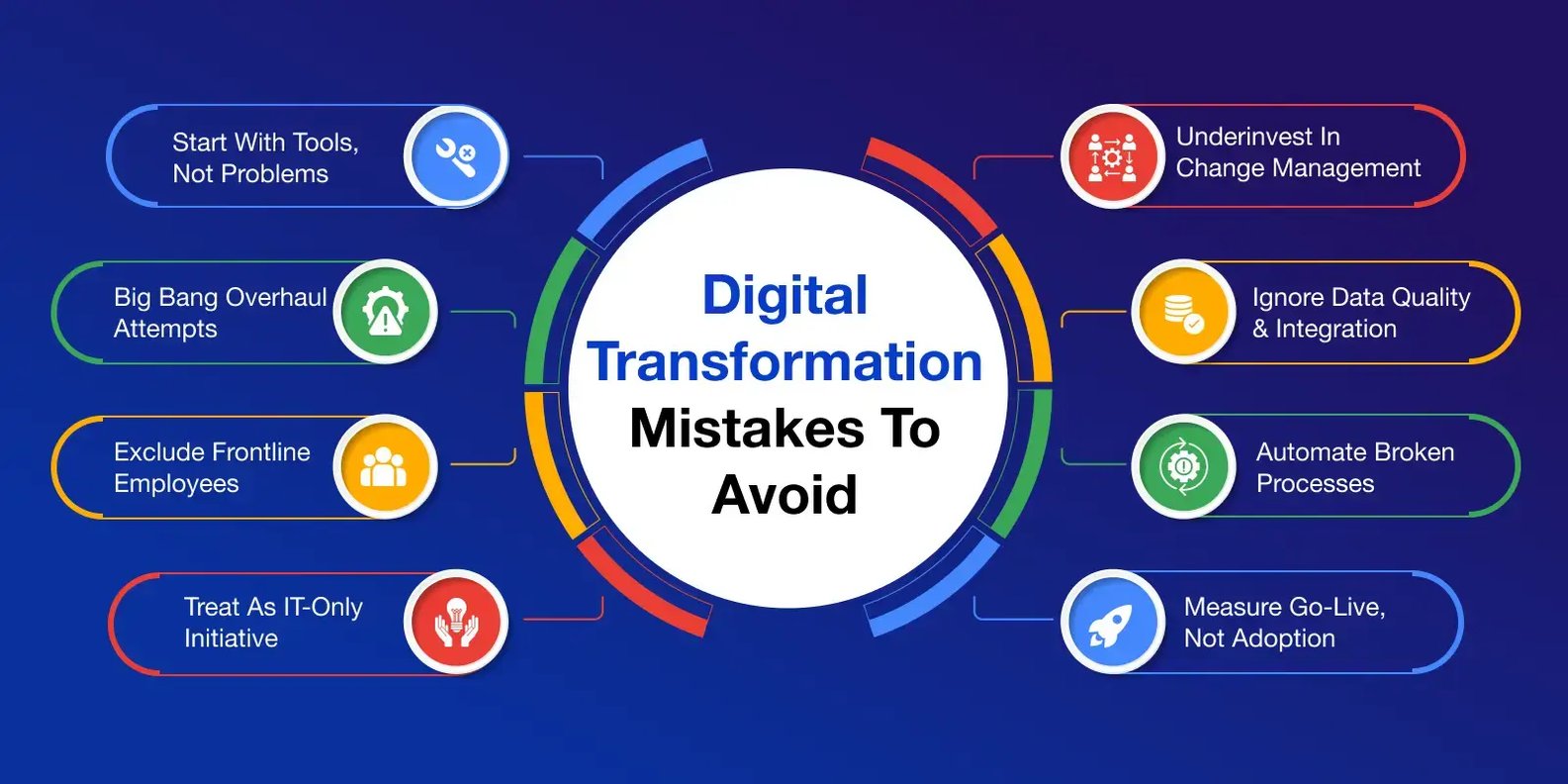
Introduction: Why Digital Transformation Fails More Often Than Businesses Expect
Digital transformation has become a strategic priority for businesses across every industry. Whether it's adopting cloud computing, implementing artificial intelligence (AI), automating workflows, modernizing legacy systems, or improving customer experiences, organizations are investing heavily in technology to remain competitive.
However, successful digital transformation is about much more than purchasing new software or adopting the latest technologies. Many projects fail because organizations focus on technology while overlooking strategy, people, processes, and long-term business goals.
According to multiple industry reports, a significant percentage of digital transformation initiatives fail to achieve their intended outcomes due to poor planning, resistance to change, unrealistic expectations, and inadequate execution.
The good news is that these challenges are often preventable. By understanding the most common digital transformation mistakes, businesses can reduce risk, improve project success rates, and maximize their technology investments.
This guide explores the critical mistakes organizations should avoid and offers practical strategies for building a successful digital transformation journey.
Quick Facts: Digital Transformation at a Glance
- Digital transformation combines technology, business strategy, and organizational change.
- Successful transformation improves operational efficiency, customer experience, and business agility.
- Technology alone does not guarantee successful digital transformation.
- Employee adoption is just as important as technology implementation.
- Continuous improvement delivers better long-term results than one-time digital upgrades.
| Digital Transformation Area | Business Benefit |
|---|---|
| Process Automation | Improved efficiency and reduced manual work |
| Cloud Computing | Better scalability and flexibility |
| Data Analytics | Smarter business decisions |
| Customer Experience | Higher customer satisfaction |
| Cybersecurity | Better protection against digital threats |
Understanding What Digital Transformation Really Means
Many businesses assume digital transformation simply means replacing manual processes with software.
In reality, it is a long-term business strategy that combines:
- Digital technologies
- Business process improvement
- Organizational culture
- Customer-centric innovation
- Data-driven decision-making
- Continuous optimization
Successful organizations transform not only their technology but also the way teams collaborate, serve customers, and make decisions.
Mistake #1: Treating Technology as the Entire Strategy
One of the most common mistakes is believing that purchasing advanced technology automatically creates business transformation.
Technology is only an enabler.
Without clearly defined business objectives, even the most advanced platforms deliver limited value.
Instead, organizations should ask:
- What business problems are we solving?
- How will this improve customer experiences?
- What measurable outcomes are expected?
- How will success be evaluated?
Technology should support business strategy—not replace it.
Mistake #2: Ignoring Employee Adoption
Employees are central to every successful digital transformation initiative.
Even the best software fails if teams do not understand or trust it.
Businesses should invest in:
- Employee training
- Change management
- Continuous communication
- Leadership support
- Hands-on learning opportunities
When employees understand how new systems improve their daily work, adoption becomes significantly easier.
Statistics Snapshot: Common Causes of Digital Transformation Challenges
| Common Challenge | Business Impact |
|---|---|
| Poor change management | Low employee adoption |
| Lack of strategic planning | Delayed project outcomes |
| Inadequate employee training | Reduced productivity |
| Weak leadership alignment | Slower transformation progress |
| Legacy system complexity | Higher implementation costs |
Mistake #3: Modernizing Technology Without Improving Processes
Many businesses digitize inefficient processes instead of redesigning them.
For example, automating a slow approval workflow without simplifying it only makes inefficiency happen faster.
Before implementing new technology, organizations should evaluate:
- Which processes create delays?
- Which tasks can be automated?
- Which workflows can be simplified?
- Which manual activities no longer add value?
Technology should optimize processes rather than preserve outdated ways of working.
Mistake #4: Underestimating Data Quality
Modern businesses rely on data-driven decision-making.
However, inaccurate or incomplete data can undermine even the most advanced business intelligence platforms.
Organizations should establish:
- Data governance policies
- Standardized data collection
- Regular data validation
- Secure storage practices
- Consistent reporting methods
High-quality data improves analytics, forecasting, automation, and customer experiences.
Mistake #5: Neglecting Cybersecurity During Transformation
As businesses adopt cloud platforms, AI solutions, and connected applications, cybersecurity becomes increasingly important.
Ignoring security creates unnecessary business risk.
Essential cybersecurity best practices include:
- Multi-factor authentication
- Regular software updates
- Secure cloud environments
- Employee cybersecurity awareness
- Data encryption
- Continuous threat monitoring
Security should be integrated into every stage of digital transformation rather than added afterward.
Organizations implementing secure digital systems often benefit from professional cybersecurity solutions alongside technology modernization.
Statistics Snapshot: Technology Priorities for Modern Businesses
| Technology Investment | Strategic Value |
|---|---|
| Cloud Infrastructure | Scalability and flexibility |
| Artificial Intelligence | Automation and smarter insights |
| Data Analytics | Better decision-making |
| Process Automation | Operational efficiency |
| Cybersecurity | Business resilience |
Mistake #6: Choosing Solutions That Cannot Scale
A solution that works for today's business may become a limitation tomorrow.
Businesses should evaluate whether technology can support:
- Future business growth
- Additional users
- New locations
- Higher transaction volumes
- System integrations
Scalable platforms reduce future migration costs and support long-term innovation.
Organizations often achieve better scalability through custom software development rather than relying solely on rigid off-the-shelf solutions.
Mistake #7: Measuring Success Only by Technology Deployment
Launching new software is not the finish line.
Businesses should monitor outcomes such as:
- Customer satisfaction
- Employee productivity
- Revenue growth
- Operational efficiency
- Customer retention
- Process improvements
Transformation success depends on measurable business value rather than completed implementation.
Comparison Table: Successful vs Unsuccessful Digital Transformation
| Successful Digital Transformation | Unsuccessful Digital Transformation |
|---|---|
| Clear business strategy | Technology without direction |
| Strong leadership support | Limited executive involvement |
| Employee-focused adoption | Minimal staff engagement |
| Continuous improvement | One-time implementation mindset |
| Scalable technology choices | Short-term technology decisions |
Mistake #8: Trying to Transform Everything at Once
Large-scale transformation projects often become overwhelming.
A phased approach typically produces better results.
Businesses should prioritize:
- High-impact improvements first
- Pilot projects
- Gradual technology adoption
- Regular performance evaluation
- Continuous optimization
Small, measurable successes create momentum for larger transformation initiatives.
The Growing Role of AI in Digital Transformation
Artificial intelligence is becoming a powerful component of modern business transformation.
Organizations increasingly use AI for:
- Predictive analytics
- Customer support automation
- Intelligent document processing
- Personalized customer experiences
- Business forecasting
- Workflow optimization
However, AI should solve genuine business problems rather than being implemented simply because it is popular.
Successful organizations align AI adoption with strategic business objectives.
Myth vs Reality: Digital Transformation
| Myth | Reality |
|---|---|
| Digital transformation is only about technology. | It combines people, processes, strategy, and technology. |
| Every business needs the same digital tools. | Solutions should align with unique business goals. |
| Transformation is a one-time project. | It is an ongoing journey of continuous improvement. |
| AI automatically solves business challenges. | AI is effective only when applied strategically. |
| Only large enterprises benefit from digital transformation. | Businesses of all sizes can achieve meaningful improvements. |
Practical Strategies for Successful Digital Transformation
Organizations can improve transformation outcomes by:
- Defining measurable business objectives.
- Prioritizing customer experience improvements.
- Involving employees early in the process.
- Investing in continuous training.
- Strengthening cybersecurity from the beginning.
- Choosing scalable technology solutions.
- Monitoring business outcomes instead of technical milestones.
- Continuously reviewing and optimizing digital initiatives.
These practices reduce implementation risks while increasing long-term business value.
Key Takeaways
- Digital transformation is a business strategy—not simply a technology upgrade.
- Employee adoption is critical for transformation success.
- Process improvement should accompany technology implementation.
- Strong cybersecurity protects digital investments.
- Scalable technology supports future business growth.
- Continuous improvement delivers sustainable competitive advantages.
Frequently Asked Questions
1. What is digital transformation?
Digital transformation is the process of integrating digital technologies into business operations to improve efficiency, customer experience, and long-term growth.
2. Why do digital transformation projects fail?
Common reasons include poor planning, lack of employee adoption, weak leadership support, inadequate training, and focusing only on technology instead of business objectives.
3. How important is employee training during digital transformation?
Employee training is essential because successful adoption depends on users understanding how to effectively utilize new technologies.
4. Does digital transformation improve customer experience?
Yes. Businesses can improve customer experience through automation, personalization, faster service delivery, and data-driven decision-making.
5. Can small businesses benefit from digital transformation?
Absolutely. Small businesses can improve productivity, customer satisfaction, operational efficiency, and scalability by adopting the right digital solutions.
Conclusion: Successful Digital Transformation Begins with the Right Strategy
The most successful digital transformation initiatives are built on thoughtful planning, clear business objectives, and a commitment to continuous improvement—not simply on adopting the latest technology. While tools such as cloud computing, artificial intelligence, automation, and data analytics can unlock significant opportunities, their true value comes from aligning them with organizational goals and customer needs.
Businesses that avoid common mistakes—such as overlooking employee adoption, neglecting cybersecurity, relying on poor-quality data, or attempting to transform everything at once—are far more likely to achieve meaningful and sustainable results. Equally important is choosing scalable solutions that evolve alongside the business and measuring success through tangible outcomes rather than technology deployment alone.
As industries continue to evolve, organizations that approach digital transformation with a strategic mindset, invest in their people, and embrace ongoing innovation will be better positioned to improve operational efficiency, deliver exceptional customer experiences, and maintain a lasting competitive advantage in the digital economy.